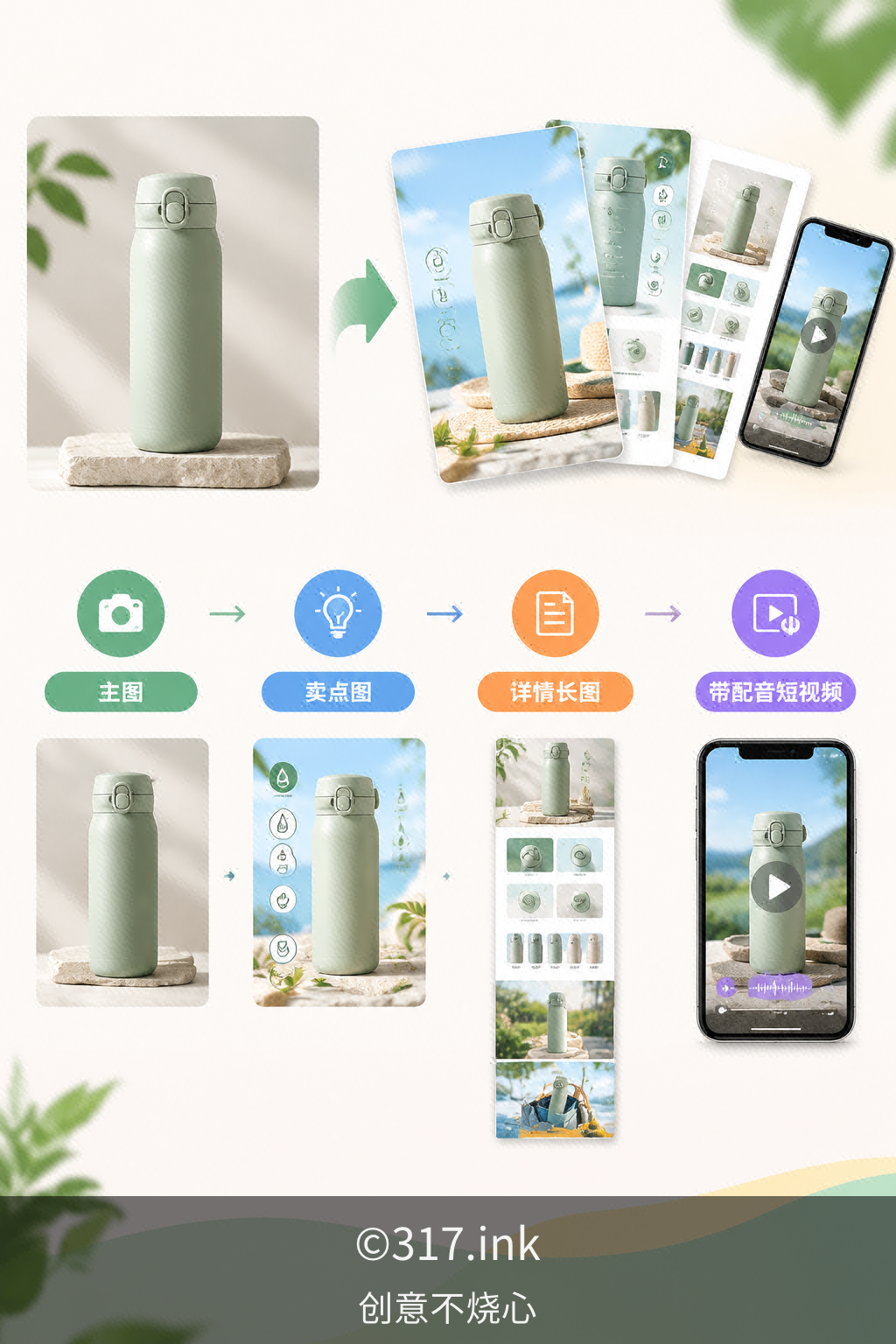
The biggest headache in e-commerce isn't a lack of images—it's having to repeatedly rework a single product photo into countless versions. Every time I launched a new product, I had to edit the main image separately, redo the layout for selling point graphics, stitch together long detail page images one by one, and finally record voiceover for short videos. The same original image bounced between several software tools: finish the main image, move on to selling points, then the detail page. Just producing images ate up most of the day, and I'd still be up late dubbing and editing videos. The worst part was inconsistent style—the main image leaned cool-toned, the selling point graphics leaned warm, and the detail page followed yet another layout. Scrolling through, users got a scattered visual experience.
The key move was feeding the original product photo into an automated pipeline that identifies the subject and whitespace areas in one pass, then batch-generates images for different purposes based on preset templates: the main image gets a unified background color and composition, selling point graphics automatically extract core information and arrange it in zones, and the long detail page is assembled vertically module by module. At the same time, it outputs a short video script with voiceover and a finished video. Throughout the whole process, I only confirmed the assets once and let the template parameters handle the rest.
The change after adopting this was pretty obvious: producing a full set of images used to take most of a day of back-and-forth, but now the same workload runs through in a single workflow with consistent style. The main image and detail page tones match, so users don't feel a jarring shift from click to browse. For the voiceover video, I no longer have to read from a script myself—the generated pacing and pauses sound natural, which eliminates the repeated recording sessions. I set the parameter list to my own habits: main image output size 800×800, fixed whitespace ratios for selling point graphic zones, uniform module spacing on the long detail page, and standard speed with background music volume lowered so it doesn't compete with the voiceover. Overall, image production has gone from endless rework to a relatively stable process.